For many Muslim parents in the UK, the idea of an online Islamic school feels both hopeful and uncertain at the same time.
You may value strong academics, but you also want your daughter to grow with confidence in her faith. You may be concerned about school environments, social pressures, or values that do not reflect what you teach at home. At the same time, you might wonder whether learning online can truly provide structure, discipline, and meaningful progress—especially for a child.
These questions are completely natural.
This guide is written to explain, clearly and honestly, how an online Islamic school works in practice. It reflects the educational approach of Haya School, where faith, learning, and character are carefully balanced to support Muslim girls aged 5–18.
What Is an Online Islamic School?
An online Islamic school is a full-time, structured school where students attend live lessons from home using secure online platforms. It is not the same as casual online courses or independent homeschooling.
At a school like Haya School, students follow:
A clear daily timetable
Live, teacher-led classes
A recognised academic curriculum
Islamic studies and character education
Ongoing assessment and feedback
The aim is to provide the consistency and quality of a traditional school, while offering an environment aligned with Islamic values.
How Lessons Are Delivered Day to Day
Live, Teacher-Led Classes
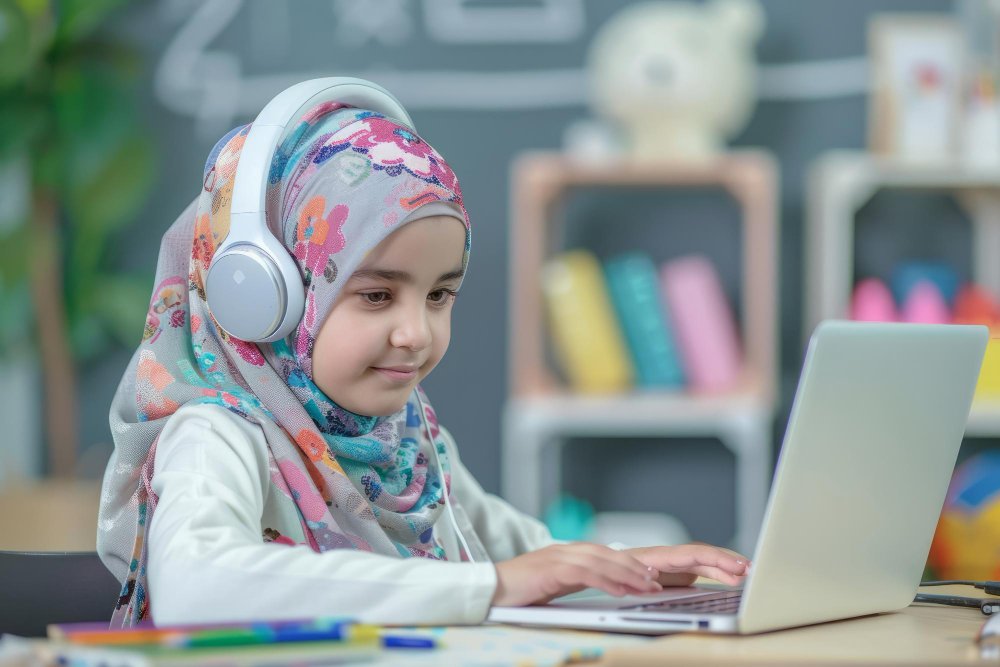
Students log in at scheduled times to attend live lessons with qualified teachers. These lessons are interactive—students can ask questions, participate in discussions, and receive guidance in real time.
Structured Timetable
Each day follows a predictable routine. This helps children develop discipline, time management, and a sense of normal school life, even while learning from home.
Small Class Sizes
At Haya School, classes are intentionally kept small. This allows teachers to understand each child’s strengths and challenges, and to provide individual support when needed.
What Subjects Are Taught?
Online Islamic schools combine academic education with Islamic learning, rather than treating faith as an afterthought.
Academic Subjects
The academic programme follows the British curriculum at Haya School, including:
English
Mathematics
Science
Humanities
Computing
Personal development
This ensures students progress through recognised Key Stages and are prepared for future qualifications.
Islamic Studies
Islamic learning is part of the weekly timetable and may include:
Qur’an recitation and memorisation
Tajweed
Islamic Studies (Aqidah, Fiqh, Seerah)
Character and manners (Tarbiyah)
This integrated approach helps students see Islam as part of everyday life, not something separate from education.
How Attendance, Behaviour, and Progress Are Managed
Attendance
Attendance is monitored daily, just like in a physical school. Students are expected to arrive on time and be present throughout lessons.
Behaviour and Expectations
Clear guidelines are set for online conduct, participation, and respect. Teachers actively manage lessons to keep students engaged and focused.
Assessment and Feedback
Progress is tracked through:
Classwork and homework
Regular assessments
Teacher feedback
Parent communication
Parents are kept informed so they understand how their child is developing academically and personally.
The Role of Parents in an Online Islamic School
Parents are partners in the learning journey, but they are not expected to replace teachers.
Their role usually includes:
Ensuring a quiet learning space
Supporting daily routines
Encouraging consistency
Communicating with teachers when needed
This partnership helps create stability and reinforces the importance of education at home.
Benefits of Online Islamic Schooling
Faith-Aligned Environment Children learn in a setting that respects Islamic values, modesty, and identity.
Safe and Calm Learning Space Learning from home reduces exposure to bullying, peer pressure, and unsafe environments.
Personalised Attention Small classes allow teachers to adapt lessons to each student’s needs.
Confidence for Girls A girls-only environment helps many students feel more comfortable participating and expressing themselves.
Flexibility for Families Online schooling supports families who travel, live abroad, or prefer a home-based learning structure.
Common Concerns Parents Have (and Honest Answers)
“Will my child become isolated?” Online schools encourage interaction through discussions, group tasks, presentations, and mentoring. Many students build strong, respectful relationships with peers.
“Is screen time a problem?” Screen use is structured and balanced with offline tasks such as reading and writing. It is purposeful rather than excessive.
“Can young children focus online?” With age-appropriate lesson design and parental support, many young learners remain focused and engaged—often more so than in busy classrooms.
“Is online discipline effective?” Clear expectations, teacher presence, and parental collaboration help maintain structure and discipline.
Online Islamic School vs Traditional School
Area
Online Islamic School
Traditional School
Islamic environment
Fully integrated
Limited
Girls-only option
Available
Rare
Class size
Small
Often large
Commute
None
Daily
Learning pace
Personalised
Fixed
Parental involvement
Collaborative
Limited
Who Is an Online Islamic School Best For?
An online Islamic school may suit families who:
Want strong academics alongside Islamic values
Prefer a calm, structured environment
Have daughters who are shy or sensitive
Value small classes and personal attention
Need flexibility due to location or circumstances
It works best when parents and students are committed to routine and consistency.
Primary and Secondary Online Education
Most online Islamic schools offer full pathways:
Online primary school for Muslim girls (ages 5–11)
Online secondary school for Muslim girls (ages 11–18)
This continuity helps families plan confidently for the future.
A Gentle Next Step for Parents
If you are exploring whether this approach suits your family, the next step is simply to learn more and ask questions.
You may choose to apply to Haya School or speak with the admissions team to understand expectations, structure, and support.
There is no pressure—only an opportunity to explore an educational option designed with care, balance, and professionalism.
Final Thoughts
Understanding how an online Islamic school works helps parents make informed, confident decisions. When delivered thoughtfully, this model can provide structure, academic quality, and a nurturing environment where Muslim girls grow with confidence in both learning and faith.
FAQs
Is an online Islamic school recognised in the UK? Reputable schools follow recognised curricula and prepare students for standard qualifications.
Do parents need teaching experience? No. Teachers lead lessons; parents support routines.
Can students move to university later? Yes, with appropriate qualifications and guidance.
Is this suitable for international families? Yes. Many students attend from outside the UK.